Categories
psychoanalysis

the silence of the child within

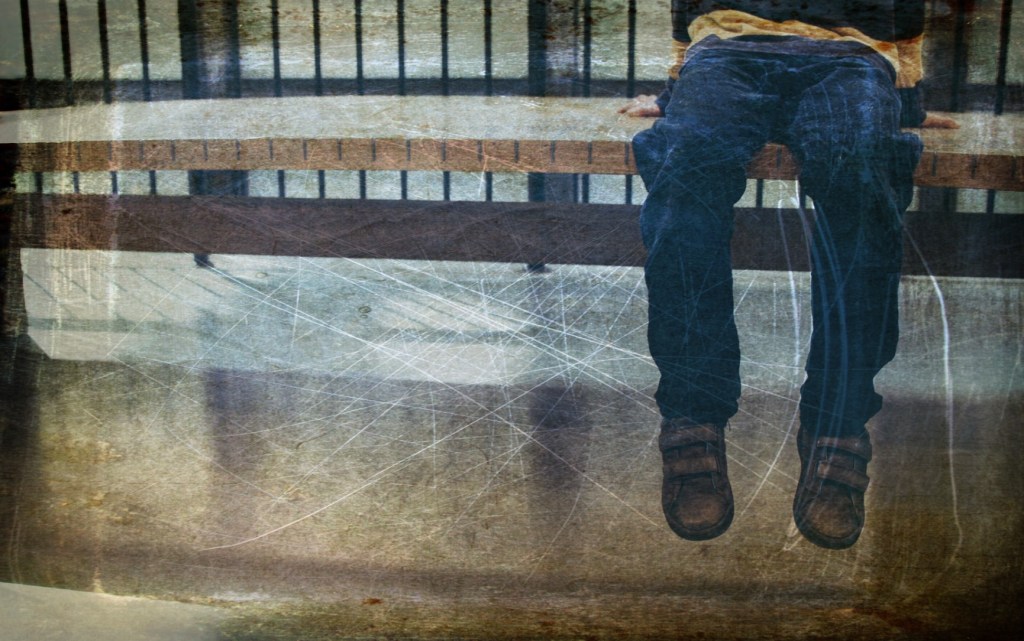
Young child sitting on high bench, with a railed banister behind. Only dangling legs, shoes, and a strip of bunched top are showing. The top appears to be striped yellow and brown, with long sleeves. The child wears jeans and brown leather shoes with Velcro straps. The original photograph is not distressed but I distressed it.
Original by Michał Parzuchowsk, distressed by me

Hey therapists of the world dealing with more or less dissociated, more or less integrated little kids living in adult patients. Know that:

1. These traumatized little kids have been waiting these many years to tell their side of the story, which is the whole of their story.

At the root of their suffering is the fact that no one ever wanted to know, and when they acted as if they did, they didn’t really hear, and by hearing, validate.

Listen to them. Trust them. If they made it this far, they are very good at knowing what they need.

2. They may be bitter and wary. The best way to get through to them, as to every human really, is to ask questions. Everyone loves to be asked questions — except the few who don’t, because their answers never led anywhere good (hint: they love questions too, but you have to earn it).

3. Most of these traumatized, more or less dissociated, more or less integrated children were never asked any questions at all. No one ever said, why are you doing this? And this, what are you doing this? And this other thing: why are you doing it? And: what do you want? What do you need? Why are you scared? Tell me, I’d like to hear. I am insanely interested in you, your very, very good reasons, your story, every single one of your thoughts and feelings and desires, however strange or bizarre or confusing any of them may feel to you. I want to hear it all. Tell me.

4. There are things the children within the adults who are your patients might never say unless you ask. They are very trained to assume adults do not want to know. If you don’t ask, they may very well assume you, like all the adults in their world, are not interested.

5. Psychoanalysis trains therapists to make space and let the voces within emerge organically. I don’t think this always works with people suffering the aftermath of severe childhood trauma, who consequently have split, dissociated children howling in pain inside. You need to ask. You need to be the adult they never met. They have been longing all of their lives to be asked.

(Sending this to my analyst, with very little hope it will make any difference, but we do try, don’t we. We try and try and try, and then, eventually, one day, we say, enough).

Categories
love psychoanalysis

What psychoanalysis owes

1. I think it’s been 2 years with this analyst: more? Some of us have trouble finding a good fit. Psychoanalysis, the discipline, is in love with making us feel — those of us who have trouble finding a good fit — that it is our fault. Or that we should turn somewhere else. Or that we should stay untreated.

2. Of course we don’t have the luxury of staying untreated, and, really, there is no one else.

3. Whose problem are we? What if psychoanalysis* really is not for those of us whose hurt is deep and massive and goes way back — and what if really there isn’t anywhere else? Maybe we are no one’s problem except our own and, if someone loves us, theirs too.

4. Does this mean that psychoanalysis fails? Maybe not. Maybe psychoanalysis is fine with being only for some people. It already is for some people — White (very few psychoanalysts of color), affluent enough, articulate enough to talk their pain through, resilient enough to stick it out for years.

5. Maybe no one, really, owes me anything, not even my analyst, who fails me repeatedly at something very, very important to me, which she regrets, and tries very much to give me, again and again, in a feedback loop of good will, love, and hurt.

6. And why should anyone owe me anything? Why should anyone owe anyone anything?

7. But this is know: I owe it to myself, and those I love, to keep trying, with the assistance of professional healers or alone, to keep trying to salve my wounds, find a way through the madness, and maybe hope the wounds won’t hurt so much, one day.

8. Here’s a confession though. I believe in a world in which we all owe each other however much love we have to give. And this love is not a smile or courtesy. This love is easing up other people’s pain, seeing them, sharing a bit of the road with them, giving whatever respite and joy they need.

9. But the trick is, we are all responsible only for our part in this. We are not entitled to others’ love. And if we die alone, unloved by other humans, we still will be able to say, I have loved.

* This blog uses “psychoanalysis” as meaning psychodynamic psychotherapy, either applied intensely as psychoanalysis proper (however you understand it) or applied intensely or less intensively as therapy.

Categories
psychoanalysis queerness

Why are we all still here

1. It’s hard to balance the facts that:

  • I make other people’s lives very difficult,
  • my own life is all but intolerable to me, yet
  • everyone wants me alive.

2. Why?

3. Gentleman Jack took me for quite a spin.

4. My analyst, who understands my being a lesbian pretty much not at all, won’t ever watch it. Maybe it’s important for queer people to see queer therapists?

5.

Two women dressed in early 19th century outfits, one light blue one back, hug while also

6. Why was there so much bitterness from my gf toward me tonight? What have I done? What should I do?

Categories
psychoanalysis

Hiatus 3

1. I am terrified by all this loss.

2. I am terrified of having to put words to it.

3. Every time I try to put words to it out of therapy people say the most ridiculous things.

4. I am so alone.

5. Therapy fails me and fails me.

6. I fail it and fail it.

7.

Photograph of  a tv screen with static.
Categories
psychoanalysis

Hiatus 3

I get heart jabs from missing my analyst.

Tenderness matters to me. The weight of it.

Weighted blanket.

Categories
psychoanalysis

Hiatus 2

1. The day is extraordinarily clear and cool. We don’t get a lot of these any more. I go to the market with the dog to buy water. It’s her first shop visit and she doesn’t have a service dog vest yet so size and meekness will have to do (Dory was small and people were often skeptical: what can such a small dog do?)

I buy 23 bottles of Perrier and the dog is perfect. I didn’t take treats so I have to rely solely on praise. Getting the bottles is exhausting but I make it to the car and when I get home I leave the bottles in the trunk, where someone else can retrieve them later.

The day is so gorgeous that we go to the park, where the dog runs and plays with other dogs but also stays close and comes when called. Again, perfection. Thankfully this is not a super active dog and after bit she is ready to go home.

We go for ice cream.

I crash massively. One tends to maintain the delusion that a good rest will fix everything but, first, a good rest doesn’t happen and, second, I emerge from my dodgy rest achy, terribly irritable, and cryful .

The ice cream was worth it, though.

2. I miss you.

Categories
psychoanalysis

Hiatus

1. Analysis needs to go slowly.

2. The patient’s only job is to love her analyst passionately and lucidly.

3.

Categories
psychoanalysis

W/e 3: Claiming

1. When I was little, maybe younger than grade school, my mom and I were driving in our neighborhood and from the back I asked, “Mom, who am I?” I remember this well because my mom said, “Ah, this is one of the questions great philosopher have asked themselves for millennia!” She left it at that and I felt absolutely awesome about being so little yet already in the company of great philosophers.

2. My mom was not much into acknowledging my awesomeness, so this moment was super special to me.

3. Recently (how long do these things take!) I’ve been asking myself what was a little girl doing with questions like that. Maybe all little children ask them as they figure themselves out. But this is where I think this question came from for me: I was an unclaimed child. I was no-one’s child. When a child is unclaimed, I think, she begins to shape herself in relation to others. An unclaimed child does not know how to be herself. An unclaimed child belongs nowhere. Since floating is intolerable, the child barnacles.

4. An adult who has barnacled all of her life has no way of knowing who she is when unbarnacled.

5. A human who cannot exist unless barnacled will not survive childhood; it may take a while but she will die. I don’t know how I did it, whether it was sheer tenacity or a hand from above. I’m going with both.

6. As an adult I have been much loved. This is both a hand from above, tenacity, and the infinite giving of the people who have loved me.

7. Still, I would be dead without psychoanalysis. The two analysts I worked with claimed me. It wasn’t easy to get there, but we did (though it’s still and always a work in progress) (many other therapists and analysts did not claim me so I was lucky to find someone who did). When the first analysis broke down I found another. This is both tenacity, a hand from above, the infinite givingness of good people, and psychoanalysis.

7. Psychoanalysis trains regular humans to great love. In this way, it is like religion at its best. (I am not saying that all psychoanalysts are good at loving their patients well, just as I am not saying that even a majority of religious people are good at love, though of course that is the only thing they should be good at since nothing else matters).

Categories
psychoanalysis

W/e more

Board wall, distressed. “PAIN” painted on top in white.

1. It’s not that I only remember pain. I remember joy too, except there wasn’t really much of it. I remember some joy, but it wasn’t real. The real joy, I do remember.

2. Consistent joy started a few years into analysis. Or maybe straight away, cuz where do you find that kind of love? But at first it was joy mingled with pain, and it made sense, because I have always experienced joy alongside pain. A few years into analysis, though, I started experiencing simple joy, consistently (well, with more consistency than I had ever known).

3. I am not saying that analysis is for everyone, but analysis is perhaps necessary for all humans whose babyhood was shaped by painjoy. These do-overs, I don’t think they are possible any other way, at least in our fucked Western world.

4. I don’t know of any other world. I just try not to generalize.

Board wall, distressed with warm colors. The word “JOY,” upside down, is painted on it in white.
Categories
psychoanalysis

W/e

1. I close my eyes. I jolt out of my sleep a few times. Decide to stick it out even though my body is freezing and run over with shock waves that make my heart pound. Eventually I sleep, peacefully, for three hours. The first long nap in years.

2. Something must be going right.

3. Communication’s always a bitch yet we must keep at it.

4. I am particularly good and also particularly bad at it.