1 There is struggle. Days are struggle. Nights, thankfully, are not, typically.
2. Prazosin. Magnesium. Nights saved.
3. How to delay rage: you tell yourself that if it’s worth raging about you can raise it the following day.
4. Rage passes.
5. On weekends you miss your analyst with the fierce sweep of passionate love.
6. Slowly she grows in constancy.
7. No one can work with me who is not willing to love me. Also not scold me. As a child I got lots of scolding and I used it as love (love in the currency of reproach and punishment). Now, scolding chars me.
8. My first analyst taught me how to take the love the was offered me. It was brutal work.
9. May the helpers be blessed. May the full-time helpers be blessed. May the healers be blessed. May the healers receive abundant gratitude and may generous gifts be bestowed upon them. May God make their lives easy and sweet.
10. May their mistakes be forgiven and they shortcomings accepted with love and gentle humor.
The other day I used the “girls don’t have penises so they use their fingers” shortcut to define lesbian sex. I felt quite ashamed later of its imprecision and crassness.
For one, men use fingers too with women and men, and women use fingers with men. In other words, fingers are not alternative to penises.
For two, sexual activity is not limited to fingers and penises, nor is it limited to insertion of tubular objects inside orifices. People use hands, lips, tongues, teeth, bellies, backs, shoulders, knees, elbows, arms, feet…
But then my imprecise and crass formulation also lent itself to the general assumption that women lack something very important and they need to make do with something — in this case fingers — that is vastly inferior.
Lesbian sex is sex and hetero sex is sex and gay sex is sex and all manner of sex is sex and I am not going to define sex here, but if you think it’s sex and it feels like sex, for the intents and purposes of its validity to you (i.e. not in relation to legal standards, necessarily) it’s sex and it is not better or worse or superior or inferior to anyone else’s sex so you get to have sex any damn way you please.
1. Every time I see any info at all about the Coronavirus I have a feeling of great longing. I know it’s selfish. I know many will suffer. But I long to catch it and die.
2. There are so many ways to die and many, many ways to keep living.
3. Hope: Every Black artist who did art in America during legal segregation. Everyone who does art at all while part of a group that is targeted by hate. (Jackie McLean was the son of a mixed Black-White couple, I think; I like the title of this album). (Psychoanalysis is art).
4. Hope: My dog near me when I wake up in the morning.
5. Hope: Anne Carson’s playfully stating something and immediately undermining it, because life is too serious a business to be encapsulated by platitudes. Ex:
From Short Talks
6. As long as psychiatry
Is rooted in power imbalance
Is predicated on patients’ inability to judge for themselves what they want/need
Is financed by pharmaceutical companies and regularly uses pharma-controlled (mis)information, to the point that APA’s conferences are sponsored by pharmaceutical companies (!)
Is coercive and regularly uses law enforcement, in a unholy alliance of medicine and police/judicial authority, to wit:
involuntary hospitalization in psychiatric units (coercion breeds abuse, invariably)
involuntary drugging inside those facilities (even when drugging is oral, patients have to demonstrate they have taken the drug or be punished)
use of punishments/rewards (“privileges”) in such facilities
the patients cannot leave of their own volition, and when they leave they might have to abide by physician-dictated guidelines (stealthy parole)
forced outpatient treatment, including
forced ECT and forced use of antipsychotic medication, which is court mandated and enforced by police (court hearings are nominally democratic but the voice of the patient is invariably overruled by the voice of the physician
forced attendance of day hospital (see above re: psych hospital’s overt and non-overt abuse of patients’ human rights)
The police are deployed to people who express mental distress and are deemed “a danger to themselves,” often with intense traumatization and brutality.
The phrase “danger to themselves” is a meaningless and authoritarian construct used solely to give some people power to dismiss and abuse some other people. It is often coupled, with or without reason, with “danger to others.”
it is an oppressive system and it must be resisted.
1.I just talked to my mom. It was fun but I had to disassociate.
2. There is a specific self that talks to my mom. She needs me to be that way. When she is happy I am happy too, to a point, so I become the self she needs me to be.
3. I will know in a bit whether this dissociation hurt me. Right now I’m still keyed up and reeling.
4. I do know that I feel enormously tired and that I don’t know how to come down.
5. J. came right after the call to tell me something and I had no idea how to talk to her. She belonged in another universe entirely.
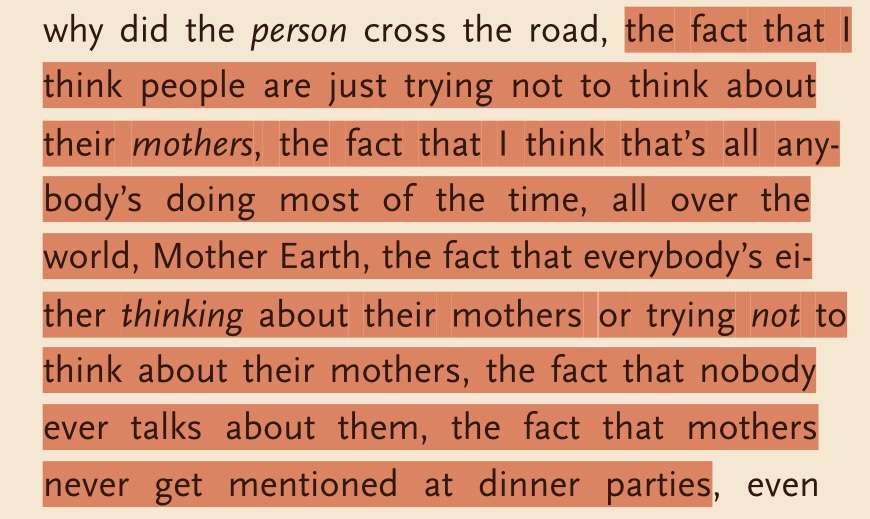
6. From Lucy Ellmann’s Ducks, Newburyport:
7. I think we all dissociate to some extent when we talk to our moms, but their is dissociation and dissociation.
8. I am quite dissociated these days. When the little girl is not raging the dissociation wouldn’t be bad except I need to interact with others and it’s exhausting.
1. We as a society, as a civilization, are so ignorant when it comes to feelings. We want to do so much, achieve so much, yet we are deeply unknowing of the building blocks of personal and collective growth.
2. We are impatient and in a hurry. We don’t have time for anything. We are poorly trained to the long view.
3. A lot of power and money is staked in our being so.
4. Here is how we resist:
we listen to others.
we ask them questions and listen deeply and attentively to the answer.
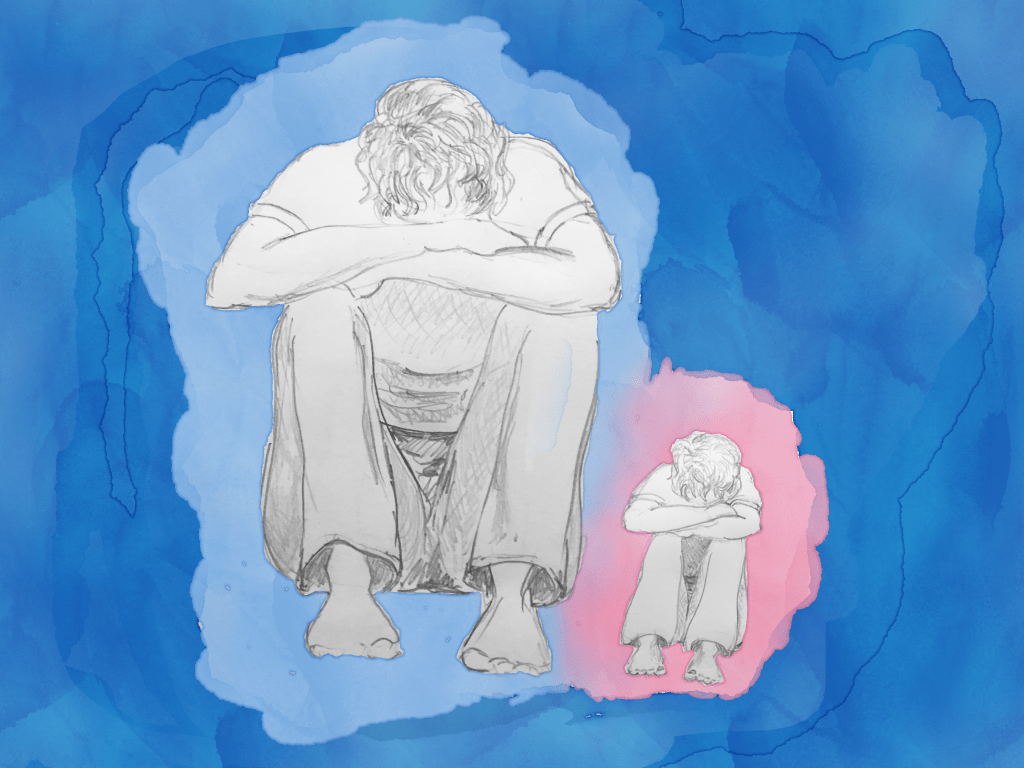
Many thanks to Jen for this beautiful drawing! Please use with permission.
1. I have been letting the little girl into the room.
2. The little girl is all manners of terrified/hurt/angry. She is difficult to deal with. The adult finds her a torment. The little girl is not a torment to herself, I don’t think, ‘tho sometimes she thinks she is bad.
3. She does not think she is bad when she is listened to and heard!
4. After about 2 years of pleading and kicking and screaming and explaining my analyst seems to have learned to talk to the little girl with tenderness, age-appropriateness, respect, and intelligence.
5. Adult me is always listening in and ready to yank the little girl back if things go wrong. The little girl’s meltdowns are brutally painful.
6. I think my analyst is afraid the little girl will get her back up if she, the analyst, uses “you” when talking to her. So she (the analyst) mostly uses “we,” as in “we can’t sleep when we are scared.”
7. The little girl would like to be talked to as a unique and well-seen “you.” In the country she comes from, this “we” sounds patronizing and diffusive. I can’t gauge whether it is the same in English.
8. Donald Trump, acquitted, immediately proceeded to kick up the dictatorship. This is absolutely terrifying. I am terrified as an immigrant and a lesbian. I am terrified as a naturalized citizen. AND I am Western European and White! The fullness at my heart goes out to all people of color in Northern and Central America now. It is terrifying. I will fight for and with you.
9. Since the little girl started talking to the analyst the adult person’s body (same as the little girl’s body?) has experienced so much less pain. For weeks she had hardly been able to move! Her body is now limber by comparison. The little girl and the adult person are so grateful to the analyst!
10. Today the little girl talked to the analyst about her childhood. She was scared at night and she couldn’t sleep. Her mom was barely there for her. She tried to be there for her youngest sister, who was in a crib. The younger sister slept in the same room as the little girl.
11. After the session she slept and had this dream:
she is an adult and also a child. she, her middle sister, and her mom are staying somewhere strange. the dreamer (me) is exhausted and disabled with a serious chronic illness and she cannot go with her mom who is
showing a lifetime of drawings in a gallery. when she is finally able to join her mom in the gallery she finds that the exhibition was and still is a smashing success. her mother, though, is detached and disconnected from all this, as if she couldn’t grasp or care about any of it. (i think the exhibition is really the dreamer’s—my—accomplishments, and the dreamer’s middle sister’s many accomplishments too).
the dreamer, exhausted, returns inside. “inside” is an underground labyrinth of small rooms, with a low ceiling, narrow, with arrowslits for windows. the dreamers asks her sister, is mom coming to get us? her sister, a bit scared, says, yes, yes, she said she would. the dreamer looks outside and it’s getting dark. she knows she won’t be able to find the exit. she is stuck. she feels terror creep over the surface of her body, make its way inside.
12. She woke up.
13. Food and hot drinks always help dispel the phantoms of past trauma. We thank our Lord and also the earth for the lovely food that restores integrity to the fragmented mind and body.
1. The other day I quoted three lines from Gentleman Jack — I am sure they are pretty accurate but I am quoting by heart.
2. As always, I can’t write in full discursive paragraphs about this because my mind is tired and fragmented, so let me use again numbered paragraphs.
3. I have always known that being a lesbian made my life difficult, but this TV show, alongside painful and incremental seeing of myself as someone who had a lesbian childhood/adolescence/twenties/life in analysis, ripped a veil of not-knowing.
4. Women go to great lengths to convince themselves that “it’s nothing.” Gay women, straight women, trans women, all women.
5. Ann Cvetkovich talks about lesbian trauma (trauma qua lesbian) in An Archive of Feelings, which I read years ago (this is not a perfect digital copy but it’s free so THANK YOU SO VERY MUCH to those who put it online!). The second chapter, “Trauma and Touch: Butch-Femme Sexualities” does particularly good work at describing the kind of pain that butches, and femmes, in different ways, accrue simply in virtue of being. The kind of butch the chapter describes is very much not the kind of butch I am, though, so, even though I was really taken by this chapter, I couldn’t apply it to me.
6. Still, if you don’t know anything about lesbian pain and lesbian trauma, this is a good thing to read. It’s particularly good because it emphasizes how femmes and butches heal each other in ways that an uninformed, quick-judging eye would find dysfunctional (hint: it’s not dysfunctional if it helps).
7. My non-lesbian, lesbian-ignorant analyst has brought me here. She has created a space in which I can grieve decades of ungrieved lesbian trauma. Sometimes you need a lesbian therapist. Other times you just need a good therapist.
8. The instant the veil of not-knowing was ripped I knew everything. The parts fell into place like tetris bits. I knew and knew and knew. And I knew that this pain started pretty fucking early.
9. Parents of queer girls: don’t underestimate the suffering of teeny tiny queer girls in playgrounds, day cares, and kindergartens. The world is truly, really designed to make them feel like they don’t belong, however good the intentions of those who surround them.
10. [flashback of tiny me tantruming in my underwear because my mom wanted me to wear a skirt].
[flashback of early grade-age me approaching the director of the choir I sang in and loved days before Christmas night because he had said, “Boys wear blue pants and white tops, girls wear blue skirt and white tops” and I knew that a) I would have to miss Christmas if he didn’t allow me to wear pants and b) I would (probably) have to lie to my mom as to the reason why. People: I loved that choir. I loved it so much I was crazy about it. And I. would. have. missed. Christmas. night. mass. Small me approaches director: “Can I wear pants?” Director looks at me puzzled, waits a beat that lasts a lifetime, then, barely thinking, says, “I don’t see why not.” People: this kind of relief, you get it a handful of times in your life. I ran all the way home and jumped on all the little walls and cavorted like mad in the street because I could sing at Christmas night mass].
11. But no, no, no, these are not good examples. These things are easy for an aware parent to catch. This is what is difficult:
When your little girl’s heart is silently and inconsolably broken because the little girl she is friends with and loves passionately does not love her passionately back because she, your girl, is just too different and the games she, your girl, plays are not the games the little friend plays and yes, yes, they are friends, but the little friend is mostly friends with other girls who are more like her. And your little girl bends herself over backward to find points of commonality: she asks to do homework together, she walks her little friend home, she brings her cookies — she tries all the things. And her hopes are raised with each successful and intimate encounter, then dashed like clockwork the following hour or the following day.
Your little girl has awesome little boy friends she gets along with like a house on fire, and a beautiful little girl friend you can do absolutely nothing to convince to passionately love your girl back.
1. The first analyst I had, analyst A, was a lesbian. This really helped validate me as a lesbian.
2. I think few comprehend the degree to which same sex loving people may be able to deny to themselves their same sex loving and even their identify as same sex loving people. We think we are bisexual. maybe. We think we can be straight if we try hard. We think all manner of things that don’t make any sense at all.
3. I write in numbered sections because I am suffering greatly and my mind is fractured. Writing in sections imposes outside order to the inside disorder and does not demand that the mind strain too much to achieve inner organization.
4. My current analyst, analyst B, is not a lesbian and does not know much about queerness, meaning, she knows as much as a competent analyst living in America in 2020 knows, but has not specifically devoted time to learning queer studies.
5. Maybe I am in touch enough with queer me that this will not have a great impact.
6. I love B but of course I can keep loving her even if I decided not to work with her. But I’ll work with her through now. This is necessary.
7. No one knows the future.
8. This is such a rough time. I am confused and fragmented. I need to allow myself whatever helps me to pull through. I am steeped in the Mad movement and not too fond of drug companies and the way the pharma-psychiatric-legal system dehumanizes people, but right now psych drugs are the only way to buy me a crutch to last this terrible time. I hate it when our desire to maintain the purity of our ideals make us feel like frauds for doing what is good for us.
I knew there were lesbians in the production team of this show at
1. Anne, to God/the skies/the ceiling: “Don’t you do this to me again.”
2. Ann: to Anne who is a million miles away, via the mirror, telepathically: “Don’t leave me.”
3. Anne: to Ann, who is holding her and looking at her with tenderness and reassurance: “Don’t hurt me.”
(This may just be historical accuracy, but that the two protagonists are both called Anne/Ann seems to me a sign of exquisite depth of understanding. Here’s one reason: the patriarchy has codified nomenclature in such a way that this never happens to heterosexual couples. Other reasons to come when democracy is in less acute meltdown and I’m less anxious and despondent about fascism in America #IowaCaucases).






 inside(r) psychoanalysis