1. How much trauma is too much trauma? How do we heal?
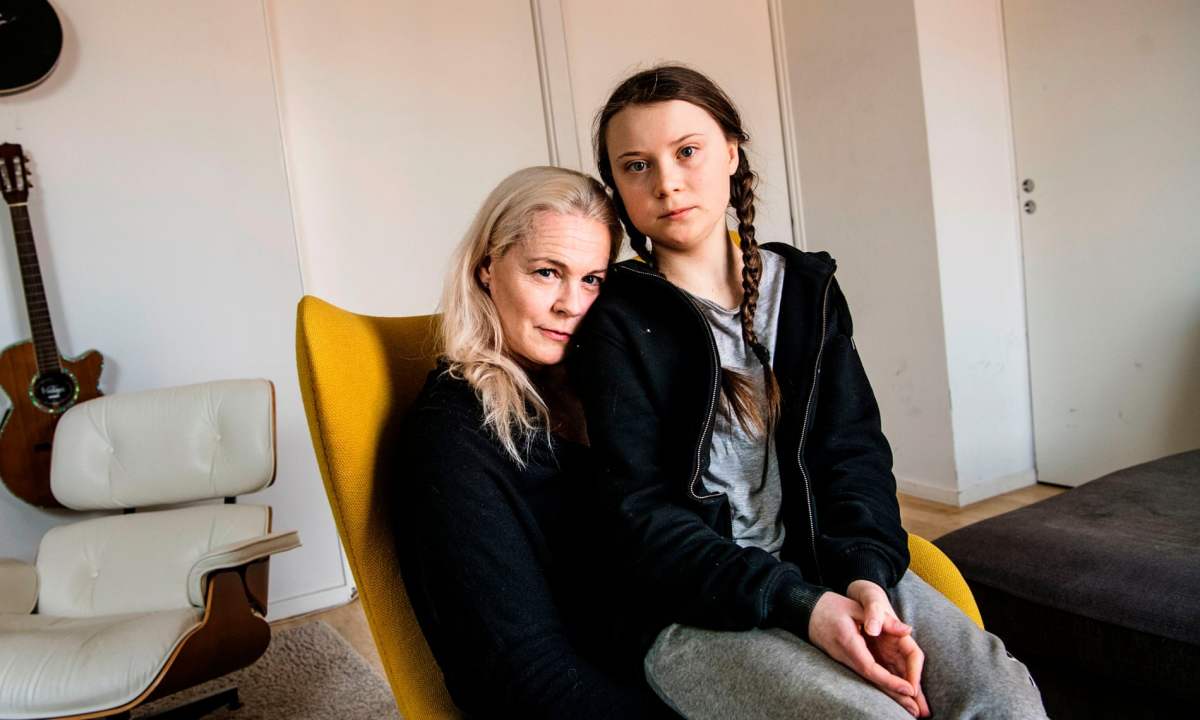
2. I just read in the Guardian a beautiful extract from a forthcoming book written jointly by the family of Greta Thunberg. This particular bit is written by Greta’s mom.
3. Healing takes a village. It also takes patience. It also takes luck.
4. I feel I have a village and I have patience, but I need a bit of luck.
5. I am a Christian but it’s hard for me right now to think of God. God is for many such a source of succor. For me now he’s a source of anxiety and also rage.
6. God, I cannot deprive myself of anything for Lent because my life could not be more pared down. If I deprive myself of more there will be nothing keeping me alive.
7. God, why do you keep letting me down?
8. Should I “deprive” myself of hopelessness? Is it possible? What will life look like without hopelessness? Should I try?
(Many apologies because I have not being able to provide alt text for images lately. It’s an unforgivable omission but I find it utterly exhausting. I’ll catch up as soon as I can)
1. Please understand I speak as a lay person. I know so little.
2. All the key notions of psychoanalytic theory and psychoanalytic practice are subverted by queerness. Approaching a queer patient with therapeutic and conceptual tools developed mostly within a patriarchal, heteronormative framework will by necessity cause pain and (re)traumatize.
3. Feminist psychoanalysis is probably a godsend, but I wouldn’t know because I haven’t read it.
4. A queer person has a history in which the development of libido and the development of the death drive go hand in hand. I mean this in the most literal sense possible: our libido was never allowed, never possible. We knew this very early on, probably as babies. Our desire was always a forbidden desire that we absolutely needed to kill. (I realize a certain psychoanalytic thinking understands all sexuality this way; please spare me).
5. Terror.
6. Suicide.
7. Suicidal baby.
8. The queer baby dies in order to survive.
9. Love is tainted. Inherently. Even if we are deeply loved.
10. We are often not deeply loved. We are strange and don’t fit. Our bodies and minds betray us and those we love every day.
11. The patient-therapist relationship doesn’t fall under the terms of traditionally conceived power relations. Using this framework to relate to the patient will hurt the patient, whose longings have already been brutally punished.
12. A new understanding of the love between the patient and the analyst is imperative.
13. Analysts are socialized in a heteronormative, patriarchal society. They need to work hard at shedding as much of their conditioning as they can.
14. We, the queer people, are inherently monstrous. We are inherently unlovable. The therapist and the patient need to dismantle the conditions of possibility of this monstrousness, together.
15. An unusual openness is required. Rules must be broken. The house has already burned down.
16. We grieve together an irreparable sorrow. We grieve together a life lost. Healing can exist only through radical rebuilding. The master’s tools…
17. Queer psychoanalytic houses are made of plasticine and wind tunnels. No one is kept out.
18. The boundaries of the self are exploded. They can be affirmed only in love.
Reviewers have read this as a story of self-absorption, but I see it instead as an investigation of the ways trauma disrupts time.
Saul, the protagonist, is a bisexual man who carries a hefty load of queer trauma. After his mother’s death his father and his brother torture him for being “inappropriately” masculine, and if you know about gender/sexuality trauma, you know that it never, ever goes away. Society will never stop being heteronormative, and every fresh reminder of your unfittingness will break the wound wide open.
When we encounter him, Soul is startlingly beautiful and universally attractive. His girlfriend has turned down his marriage proposal and, since he’s a scholar of the GDR and, fittingly, also a scholar of male dictators and their attitudes toward women (is he himself the women dictators abuse?), he goes to East Berlin to do research. In East Berlin traumatized, queer Saul lives that most heady of all times: the miraculous point in one’s youth when suffering and delight are equally acute and plentiful, and life feels like a torrential, delicious flood of pathos, lust, and love.
No one can stay long in such time. People prolong it with drugs but it inevitably ends. The mind cannot take all that intensity, and life anyway doesn’t work that way.
The non-traumatized mind (or the not-too-traumatized mind) moves on, looks back with nostalgia or embarrassment, incorporates the past into the present through memory, and finds a way to create satisfaction and contentment (and joy!) in adult living. The traumatized mind remains stuck in the past and the past is the present and its presence and absence equally torture us.
Levy is doing two things here:
The first is the thought experiment, would you survive a trip into your headiest days? Could you carry on after the acute re-experiencing of what you had and lost?
The second is an investigation of the mind of those who cannot but live in two places at once — the suffering and excitement of their past, the inevitable disappointment of their present.
I think the thought experiment is not really the point here. I think the point is that saul needs to go back, and back, and back, and both fix the terrible things that happened to him and also relive the grand things that happened to him and, this time, make them last, make them not go away. He needs to be back there and make it all override the way his life has become.
I love levy’s portrayal of the free, whirlwind, reciprocated desire Saul experiences in East Berlin. It’s beautiful and queer and delightful. Saul is innocent and kind, forgetful and selfish; he gets to have a second, less troubled childhood. He is hurt and he smothers this hurt in sex, as queer people sometimes do. Queer sex connects Saul to himself and heals, to an extent, or for the moment.
We don’t really know what the rest of saul’s life is like. We know he is loved, at least by some, and we also know that he fails massively at being happy.
Time is a kindness. Queer-traumatized people, most of us, find some relief in the dulling that time brings. How can one survive reliving freshly the moments when everything was still possible? Maybe one can’t.
1. I started this as a way to keep in touch with my analyst.
2. I resumed this as a way to keep in touch with my new analyst.
3. Write is what I do.
4. I want to post book reviews here.
5. My analyst stopped reading my book reviews so I stopped sending them to her.
6. I don’t think she knows the role books play in my life.
7. This is not about her not reading my reviews. This is about her not knowing what books mean to me.
8. Here’s on thing: without books I wouldn’t have made it through childhood.
9. Without books I wouldn’t have made it through life.
10. I will post book reviews here. This is how I learn, by reading and thinking. This is how I keep alive.
11. I’ll send them to her and she is welcome not to read them.
12. I will review here the books I read.
13. My book reviews were really meant for her but when she stopped reading them they stopped being for her.
14. Is life being able to bear disappointments? I think it is. I wish I were able to find the joy though. Is there someone life gives you beside what it takes away?
1. Banana bread with choc chips, walnuts, yogurt and jenmagic. We brought some to the downstairs neighbors who are always in need of appeasing because of my nocturnal life.
2. Huge confederate flags at early voting sites in NC. God save us all.
3. The patriarchy is having a very good time in America. The white heterosexual patriarchy that is. A pox on it.
4. The day is ending well. Praise be to the Lord.
5. I do invoke God, the Lord, etc. with playfulness, but in reality I cannot imagine existing without faith in an everloving, tender, endlessly providing God who is my mother my father my sister my lover my friend.
6. Faith lives best in our actions, far from our mouths. It is for others to call us Christians.
1. I haven’t thought much about butch-femme dynamics. Maybe I am not particularly interested in them; maybe I find lesbian subcategories stressful. I am on the butch side of the butch-femme continuum, and I fit Ann Cvetkovich’s discussion of butch-femme healing (An Archive of Feelings, chapter 2, 2003) to an extent, but I’m not super butch. I am a little butch.
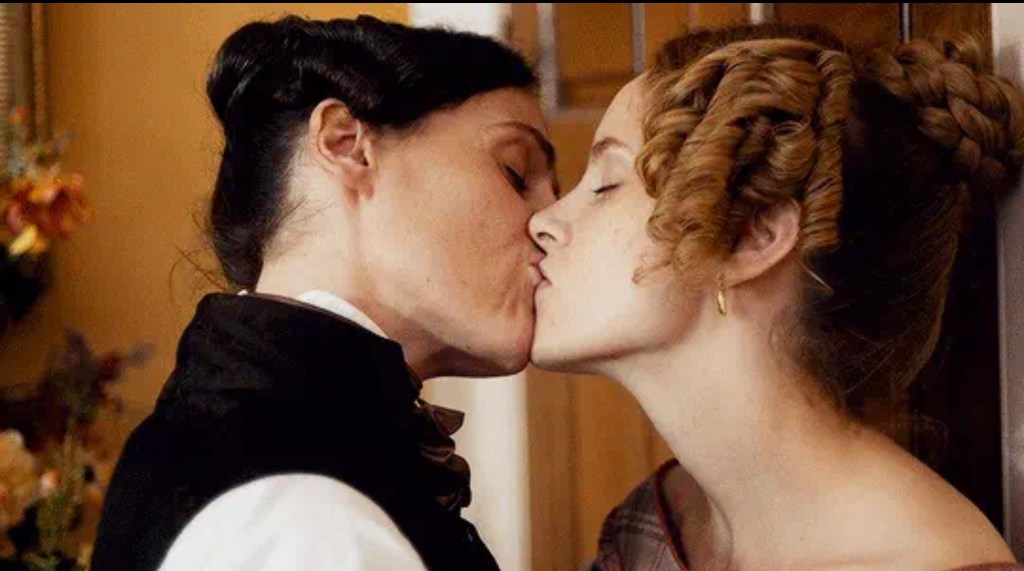
2. Sally Wainwright’s Gentleman Jack lends itself to butch-femme analysis. Since, as I said, I am not very knowledgeable about this topic my thoughts will be informed by other studies or by my general knowledge of queerness and, of course, by my personal experience. This is the first of what I hope will be a series of posts.
3. There is no world in which Ann Walker (AW) could express the absolute delight she feels at seeing Anne Lister (AL) again for the first time since she was a young girl if
they were of two different genders
they were two men.
The endless latitude of feelings and expression of feeling allowed women is one of the blessings and one of the curses of lesbian existence.
4. A blessing because closeted lesbians, or even out lesbians in non-romantic female friendships, get to enjoy a high level of intimacy with women they are romantically/sexually interested in but who are not equally interested in them.
5. A curse because this intimacy, this closeness, is always in tremendous jeopardy — no one knows what will happen the instant the love that dares not speak its name is named.
6. Women can actually get quite far along the physical intimacy road as long as that love, the one that dares not speak its name, remains unnamed.
7. Or at least they can in a fairly repressive, homophobic society. Because, the more that love is assumed not to exist, not to be possible, the easier it is for everyone to ignore it.
8. In cultures that accept same sex love, it may be harder. Girls who get too close are immediately capable of telling themselves that this is too homoerotic, too gay, and will pull back if they don’t want to go there, or can’t go there.
9. Intimacy is almost always erotic. We are all well trained to channel this eroticism into socially-approved feelings and behaviors. Close female friendships — friendships in which women spend a lot of time together, touch a lot, disclose a lot of person stuff, talk a lot — will tend to the erotic. Straight women are trained to channel this eroticism in socially-approved ways. So are lesbians.
10. In order to do so, lesbians who long for more must live in a perpetual state of (self-)denial. This (self-)denial is multiform. At its outermost end, that means treading the intimacy line so as to satisfy desire without threatening the other; at its innermost end, it will entail hiding one’s own desire to oneself.
11. In an extremely homophobic society this state of constant self-denial comes with great agony. In a less homophobic society (say Miami in 2020), when the possibility of finding a partner and living a lesbian life is there, there is less agony because there is hope.
12. But you have to get there. You have a find a woman who returns your love. You have to find a woman who accepts to live openly with you. You have to find a woman who is brave enough and gay enough to live out her sexuality.
13. The road to finding this woman is full of emotional hide-and-seek, and disastrous misreadings and ruinous declarations.
14. AL is phenomenally assured in who she is and what she wants, and also in the viability and righteousness of the fulfillment of her desires. When she first approaches AW she does so with exactly the same calculus that leads to heterosexual unions in her social environment. This calculus takes into account financial benefit, compatibility in social class, desire to achieve a comfortable and stable domestic situation, and finding the other person at least moderately appealing. AL would be quite fine with obtaining all that with a woman she is not in love with but who is not distasteful to her, because, just like her heterosexual counterparts, she would be counting on growing fondness. She could never marry a man because her distaste towards men, romantically speaking, is absolute.
15. The show doesn’t make clear whether AL likes men in non-romantic contexts. Almost all her positive interactions in the show are with women (unless the men work for her), but we know that she studied with men abroad.
16. This is a complicated point. Women who are not interested in men romantically but enjoy them in general, as friends for instance, can still marry them, either because of heterosexual social pressures or for other reasons, and be more or less okay. But now my mind goes to Gertrude Stein, who only liked the company of men and deeply disdained the company of women. Yet I cannot for the life of me imagine her married to a man. Her devotion to Alice was absolute.
17. And now I go back to AL: does she enjoy women socially? We do not know. Wainwright shows her mostly engaged in flirtatious/romantic/sexual interactions. Maybe she will let us know in the next season.
18. AW, who is a femme and therefore better able to disguise herself, is, luckily for AL, also fairly clear about her desires. She knows she doesn’t want to birth children, which I take to be the show writers’ (Wainwright hired lesbians for writing and historical consulting) way of telling us that she doesn’t like having a penis in her vagina (this seems a safe way for AW, who is not only a woman of her time but also traumatized by rape, to talk about sexual intercourse). We also know that she has always refused marriage and that she does not desire to get married at all. We do not know if she has loved any woman other than AL, but of course we wouldn’t know because —
19. she herself didn’t know that she had always been in love with AL (see above re: infinite capacity of lesbian denial). We, on the other hand, immediately recognize in her ecstatic welcoming of AL back into her life the lesbian desire we will be proven right to see.
20. Not only that. We absolutely rejoice in the fact that AL may have found, not a possibly straight woman she must endeavor to conquer, but, maybe finally, another lesbian!
21. Which takes us to a key motif, both within the show and possibly for the spectator herself: the devouring lesbian who “cannot be trusted with women” because, with evil lures, she invariably manages to seduce them and utilize them for her own perverse desires. (Representations of this trope abound; the first that comes to mind right now is the 2006 film Notes on a Scandal).
22. The trope of the voracious predatory lesbian (always older, as lore would have it) rests on a true feature of (female) sexuality and two mainstays of patriarchy.
The true feature of female and maybe all sexuality is, as I have discussed above, the erotic component of intimacy. In other words, people who love each other love each other, and sex, in all its manifestations, is a component of love. That women may be more in touch with all this is simply a feature of our culture.
The first mainstay of patriarchy is that women are for men and when a woman seduces another woman she ruins her for all men, who are rightfully entitled to her through birthright.
The second mainstay of patriarchy is that men get to seduce women freely and abundantly, whether they (men) want them or not, whether they love them or not, even whether they like them or not. In other words, it is a sport and a habit and simply second nature. Moreover, they don’t just seduce them with spirited, flirtatious conversation and “accidental” brushing of fingers, but with all those other ways we are coming to recognize as sexual harassment or outright abuse. It is men who are entitled to this seduction of women. It is for them to practice. It is their province alone.
23. I was surprised by my own reaction to this show. Alongside the intense delight, the suspense, and the pain I felt, I also found myself somewhat squeamish about AL’s forwardness, the way she went about finding a companion, and the lack of compunction she had about getting AW to love her. I had to think hard about this feeling of distaste. Was it coming from a lifetime of timid lesbianism — from internalized fear and disapproval? Or was it the product of an ethical code about the way we should all relate to each other?
24. Then I thought about Jane Austen. I thought about eligible bachelors and unmarried young women, about poor relations and parsons in search of a wife, about more poor relations and the out-of-their-league men they aspire to. Love, when it happens, is a felicitous side occurrence. The main goal is marriage. Settling down, as AL’s aunt would have it.
25. When AL sets out to get herself a wife she does it in exactly the same way as men and women of her time and class set out to get themselves spouses. We don’t feel distaste at Elizabeth Bennett’s plans on her eligible bachelor, nor at Bingley’s decision to cast his lot with the calmer Bennett sister of compatible age.
(Next installment: Did she have to have sex with her though?!)






 inside(r) psychoanalysis